

Non-destructive testing of welds is a set of fundamental techniques for verifying the quality and integrity of welds without compromising their structure. These methods are indispensable in many industrial sectors, where the safety and reliability of welded components are essential elements to ensure the proper functioning of plants and infrastructures.
What is a non-destructive test?
Unlike destructive testing, which requires breaking or damaging the analyzed part, non-destructive testing allows the weld to be examined accurately without altering its physical properties. These techniques can help identify defects such as porosity, inclusions, cracks, over-welding , or penetration problems that could compromise the safety of the component. The main advantage is therefore to be able to inspect the quality of the weld during and after the production process, thus ensuring compliance with international regulations and standards.
Main control techniques
There are several techniques used in non-destructive testing of welds, each of which adapts to specific needs and types of materials. Among the most common are:
- Ultrasound: This technique uses high-frequency sound waves which, traveling through the material, allow any internal discontinuities to be identified. Ultrasonics are particularly effective at detecting hidden defects, such as cracks or sticking, and offer fast and accurate results.
- X-ray: Using X-rays or gamma rays, radiography allows the inside of the weld to be visualized. The images obtained allow internal defects to be highlighted with a high degree of accuracy. Although the process requires special safety precautions, it is a very reliable method for in-depth analysis.
- Penetrating liquids: This technique consists of applying a colored or fluorescent liquid to the surface of the weld. The liquid seeps into the small cracks or imperfections, making them visible once the excess substance is removed. It is a simple and fast method, particularly suitable for checking surface defects.
- Magnetic particles: Used for ferromagnetic materials, this method involves the application of a magnetic field followed by powdered particles. Irregularities, on or near the surface, disperse the field, creating an area of particle accumulation that signals the presence of defects. It is a very effective technique for detecting cracks and discontinuities.
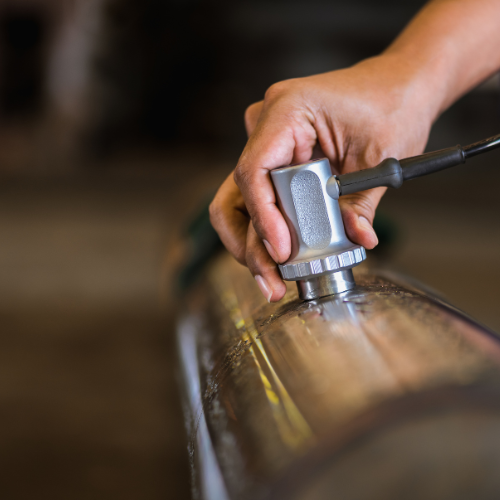
Ultrasuoni
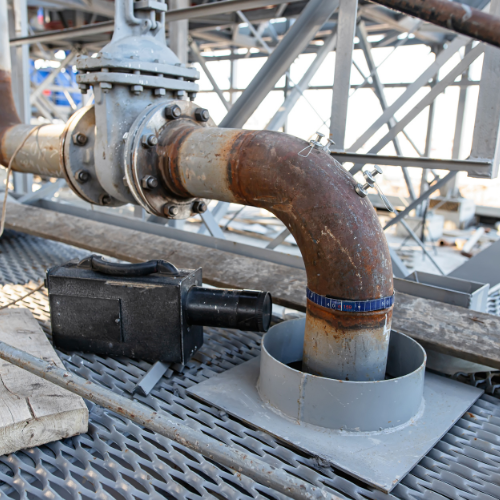
Radiografico
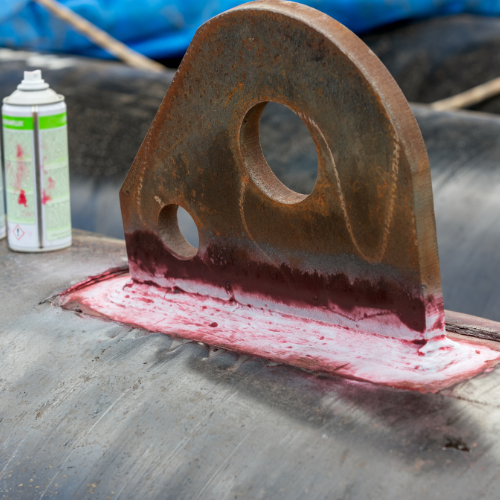
Liquidi Penetranti
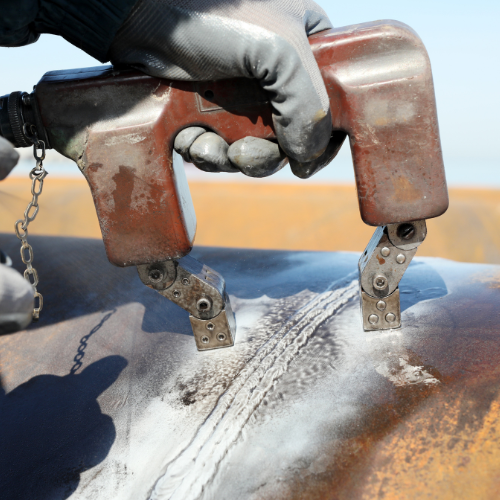
Magnetoscopia
Why are non-destructive testing of welds important?
The use of non-destructive testing on welds is crucial to ensure the safety and reliability of structural components. In industries such as aerospace, shipbuilding, energy, and industrial construction, even a small defect can lead to serious consequences, such as structural failures or critical malfunctions. Carrying out regular inspections not only prevents accidents, but also reduces maintenance costs and any extraordinary repairs.
In addition, non-destructive testing is an important tool for compliance with international standards, such as those established by ISO 3834 and EN 1090. These standards define stringent criteria for weld quality, which must be met to ensure the proper functioning and durability of components. The correct application of control techniques therefore contributes to creating a safer working environment and protecting the integrity of the systems.
CR Inspection, your partner for non-destructive testing
CR Inspection, through its certified organization distributed throughout the Italian territory, is the right and reliable partner for the execution of non-destructive tests. We offer punctual execution, complete assistance and transparency in costs. Our team of experienced technicians is certified and ready to offer customized solutions to meet your specific needs. In addition, as a certifying body, we not only carry out the checks, but also certify the employees, using highly qualified technicians who are also teachers and examiners. This expertise not only guarantees compliance with the highest quality standards, but offers customers the security of relying on experienced professionals who are up-to-date on the methodologies and innovations in the sector.
To find out more, you can contact our service contact person, Niccolò, at 328 6949955 or email niccolo@crinspection.it.